
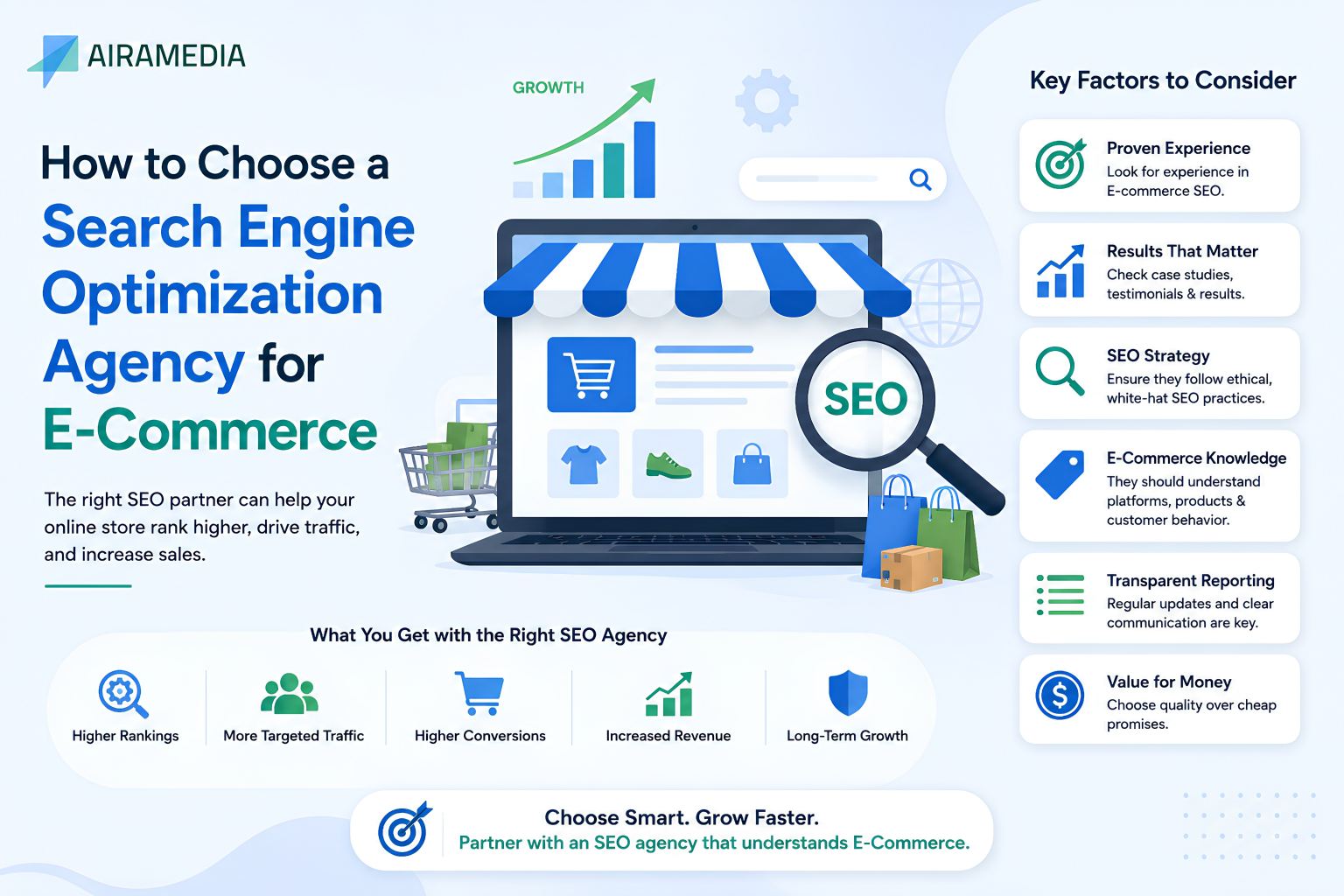
How to Choose a Search Engine Optimization Agency for E-Commerce
If your ecommerce store has hundreds, or even thousands, of products, SEO can become difficult surprisingly quickly. One product page may rank while another remains invisible. A category may attract impressions but almost no clicks. A filter can create hundreds of URLs that add little value, while an important product sits several clicks away from the homepage. You may even have a technically sound website that still fails to attract the people most likely to buy.
That is where choosing the right search engine optimization agency for e commerce can make a meaningful difference.
Professional ecommerce SEO is not simply about putting keywords into product descriptions. It involves understanding what customers search for, mapping those searches to the right pages, improving crawlability and indexing, strengthening internal links, optimizing product and category pages, creating useful supporting content, and measuring whether organic visibility is contributing to commercial goals. Google itself recommends paying attention to ecommerce site structure, product data, structured data, URLs, pagination, and how products are made discoverable to search engines.
The challenge for a business owner is knowing what to expect from an agency before signing a contract. So, rather than giving you another generic list of SEO tips, this guide explains what a capable ecommerce SEO partner should actually do, how to evaluate one, what questions to ask, and where WordPress SEO services fit into the picture.
What Does an Ecommerce SEO Agency Actually Do?
An e commerce SEO agency helps an online store become easier for search engines to crawl, understand, and connect with relevant searches. More importantly, a good agency tries to connect SEO activity with the commercial journey: discovery, consideration, product evaluation, and purchase. That means the work can extend from technical fixes behind the scenes to the words customers see on category and product pages. The goal is not to generate traffic simply for the sake of producing a larger number in an analytics report.
Think about an ecommerce store like a physical supermarket. If your products are scattered randomly across the building, the signs are confusing, aisles are blocked, and the best products are hidden at the back, having excellent products will not solve the problem. Ecommerce SEO creates the digital equivalent of clear aisles, useful signs, logical categories, accessible products, and helpful information. Google explains that its systems use relationships between pages and internal links to understand the relative importance and structure of ecommerce content.
From rankings to revenue
A professional agency should look beyond rankings alone. A keyword moving from position 18 to position 9 can be encouraging, but the more useful question is whether that visibility brings qualified visitors who interact with your store and contribute to sales. Depending on the business, meaningful SEO metrics can include organic revenue, non-branded clicks, conversions, qualified traffic, product visibility, category performance, indexed pages, and improvements in search demand coverage.
This is particularly important for ecommerce because not every keyword has equal commercial value. Someone searching for “how to clean leather shoes” is at a different stage from someone searching for “buy men’s leather shoes size 10.” Both searches may be valuable, but they require different content and different conversion paths. A good ecommerce SEO strategy recognizes these differences instead of treating every keyword as if it were equally valuable.
Why ecommerce SEO is different
Ecommerce websites create SEO challenges that many smaller websites simply do not have. A store can have thousands of URLs generated by product variations, filters, sorting parameters, search pages, and category combinations. Products can go out of stock, categories can change, URLs can be migrated, and manufacturers can provide descriptions that appear across hundreds of competing websites.
Google’s current ecommerce guidance specifically addresses issues such as URL structure, navigation, pagination, incremental loading, product data, and structured data.
That is why ecommerce SEO requires both marketing judgment and technical understanding. An agency may need to decide which products deserve more internal links, which category pages should target broader searches, which filters should be crawlable, which pages should be consolidated, and where new content can capture demand.
When Should You Hire an Ecommerce SEO Agency?
Not every online store needs an agency immediately. If you have a small catalogue, limited competition, strong technical skills, and enough time to learn SEO, you can handle many fundamentals yourself. The question changes when SEO becomes too complex, too time-consuming, or too commercially important to manage casually.
One obvious signal is stagnation. If your website has been online for months, you have published products and content, but organic visibility remains weak, there may be an underlying problem rather than simply a lack of blog posts. Another signal is rapid growth. When an ecommerce store expands from dozens of products to hundreds or thousands, the SEO architecture that worked at the beginning may not scale properly.
Signs your store needs professional SEO
You may benefit from professional support if:
- Important product pages are not indexed.
- Category pages receive little organic traffic.
- Organic traffic is increasing but sales are not.
- Your site has many duplicate or near-duplicate URLs.
- Product descriptions are thin or copied from suppliers.
- You have recently migrated platforms or redesigned the site.
- Organic rankings dropped after technical changes.
- Google Search Console shows indexing or crawling problems.
- You do not know which keywords should target products versus categories.
- Your competitors consistently capture searches you believe should belong to your store.
Hiring an agency should not be about handing over responsibility and forgetting about SEO. The best relationship is collaborative. You provide business knowledge, products, margins, customers, seasonality, stock priorities, and commercial goals, while the SEO team provides search expertise, technical analysis, prioritization, and execution.
What Should Ecommerce SEO Services Include?
A serious ecommerce SEO agency should be able to explain exactly what it will improve and how those improvements will be measured. Avoid vague packages that simply promise “monthly SEO” without defining the actual work.
Keyword and search-intent research
Keyword research for ecommerce is more than collecting high-volume phrases. The agency should understand the relationship between broad category searches, specific product searches, informational queries, comparison searches, and transactional terms.
For example, a furniture store might target:
| Search type | Example | Likely destination |
|---|---|---|
| Broad | office chairs | Category page |
| Specific | ergonomic office chair | Category/subcategory |
| Product-focused | mesh ergonomic chair | Product/category |
| Informational | best chair for back support | Buying guide |
| Comparison | leather vs mesh office chair | Comparison content |
| Transactional | buy ergonomic office chair | Category/product |
This mapping prevents a common SEO problem: forcing one page to rank for every possible variation. A well-structured ecommerce site gives each important search intent an appropriate destination.
Product and category page optimization
Product pages should provide enough information for both shoppers and search engines to understand what is being sold. That includes descriptive titles, useful copy, accurate specifications, clear images, availability information, pricing, reviews where applicable, and logical navigation.
Category pages deserve equal attention. Many stores invest heavily in product pages while leaving category pages almost empty. Yet category pages can target broader commercial searches that individual products cannot naturally cover. Google recommends informative product descriptions and category descriptions that correspond with the terms shoppers use when searching.
The aim is not to write enormous blocks of SEO copy at the bottom of every category page. The better approach is to make the page genuinely useful: explain what the category contains, help shoppers choose between options, answer important questions, and make the products easy to discover.
Technical SEO for Ecommerce Websites
Technical SEO is where a professional agency can uncover problems that are almost invisible to ordinary visitors. A shopper may see a perfectly attractive store while Google encounters thousands of unnecessary URLs, broken links, duplicate pages, blocked resources, poor internal linking, or content that is difficult to discover.
Crawling, indexing and URL control
The first question is simple: Can search engines find and understand the pages that matter?
Google describes Search as a process involving crawling, indexing, and serving results. A page can fail to perform because it was not discovered properly, cannot be indexed, contains weak or irrelevant content, or does not adequately satisfy the search intent.
Ecommerce stores often need particular attention around:
- XML sitemaps
- Canonical URLs
- Robots directives
- Duplicate pages
- Faceted navigation
- Pagination
- Redirects
- Broken internal links
- Out-of-stock products
- Product variants
- JavaScript-rendered content
- Mobile usability
- Site speed and Core Web Vitals
- Indexing of important category and product pages
Google also recommends descriptive URL structures and reducing unnecessary alternative URLs that return substantially the same content.
A technical SEO audit should therefore identify the problems that matter commercially rather than producing a massive spreadsheet of minor warnings. A hundred low-priority recommendations are less useful than five clearly prioritized issues that are preventing important products from being discovered.
Ecommerce Site Architecture and Internal Linking
Your website structure tells search engines, and shoppers, what belongs where. A sensible ecommerce architecture might look something like:
Homepage → Category → Subcategory → Product
For example:
Home → Running Shoes → Men’s Running Shoes → Lightweight Trail Running Shoes
This structure creates a logical route through the catalogue. Internal links then reinforce those relationships.
Google specifically recommends making products reachable through navigation and internal links, noting that Googlebot generally does not rely on submitting searches into a site’s internal search box to discover products.
This has an important practical implication: if an important product can only be found by using your site’s search feature, you may be making Google’s job unnecessarily difficult.
Internal linking should also reflect business priorities. Best-selling products, strategically important categories, seasonal collections, and high-margin products may deserve stronger visibility within the site’s architecture.
Product Structured Data and Google Merchant Center
Ecommerce SEO also involves communicating product information clearly to Google. Structured data gives search engines machine-readable information about elements of a page, while Google Merchant Center provides a dedicated way to share product information.
Google says product structured data can increase eligibility for Product rich results and can help Google understand details such as price, discounts, and shipping information. Google also explains that Merchant Center can provide product information for additional Google surfaces, including the Shopping tab.
This does not mean adding schema guarantees rankings or rich results. Structured data is better viewed as a communication layer: you are giving search engines clearer information about what the page represents.
For an ecommerce business, an SEO agency may review:
- Product structured data
- Breadcrumb markup
- Organization information
- Review-related markup where appropriate
- Product identifiers
- Price and availability information
- Merchant Center product feeds
- Shipping and return information
- Consistency between website and feed data
The important point is accuracy. Structured data should represent information that is genuinely present and relevant to the page.
WordPress SEO Service for WooCommerce Stores
If your store runs on WordPress and WooCommerce, a wordpress seo service can be particularly useful because SEO performance depends on more than installing an SEO plugin.
Plugins can help manage titles, meta descriptions, XML sitemaps, canonical information, and other settings, but they cannot automatically create a sound SEO strategy. A store can have a perfectly configured plugin and still suffer from poor category architecture, duplicate content, weak product copy, indexing problems, slow templates, or an ineffective internal linking structure.
A professional wordpress seo optimization service should therefore examine the whole website rather than focusing only on plugin settings.
Common WordPress SEO problems
WooCommerce websites can encounter issues involving:
- Duplicate product or taxonomy URLs
- Poor category structures
- Thin product descriptions
- Tag archives with little value
- Filter and parameter URLs
- Plugin conflicts
- Excessive scripts
- Slow page templates
- Incorrect canonicalisation
- Poor image optimisation
- Broken redirects after product changes
- Incorrect schema implementation
The best solution is rarely “install another plugin.” More plugins can sometimes create additional conflicts, unnecessary code, or overlapping functionality. A better approach is to identify the actual problem first and then use the simplest reliable solution.
Content and Digital PR for Ecommerce SEO
Content still has an important role in ecommerce, but it should support the buying journey rather than exist simply because someone decided the website needs “two blogs every week.”
Useful ecommerce content answers questions that product pages cannot answer efficiently. Buying guides, comparisons, sizing advice, maintenance guides, product explainers, and category education can help capture searches earlier in the customer journey.
For example, an outdoor equipment store could create content around choosing a sleeping bag for different temperatures, then naturally connect that content to relevant product categories. The content becomes a bridge between an informational search and a commercial page.
Off-page SEO can also support ecommerce visibility through digital PR, editorial mentions, relevant partnerships, expert contributions, and genuinely useful resources that earn references. The objective should be quality and relevance, not a large number of questionable backlinks.
Google’s Search Essentials explicitly recommends people-first content and warns against tactics designed primarily to manipulate search rankings.
How to Choose a Search Engine Optimization Agency for E-Commerce
Choosing an agency is not simply a matter of comparing monthly prices. You are effectively choosing a partner that will influence your website’s architecture, content, technical health, and organic acquisition strategy.
Start by asking how the agency approaches your specific business. If the first conversation revolves entirely around keyword rankings without discussing products, customers, margins, competitors, catalogue structure, technology, or conversion paths, that should raise questions.
A capable agency should be able to explain what it will investigate before recommending what it will change.
Questions to ask before hiring
Ask potential agencies:
- How will you audit our current ecommerce website?
- How will you prioritise technical issues?
- How do you separate product and category keyword targets?
- How will you handle faceted navigation and duplicate URLs?
- What will you do with out-of-stock or discontinued products?
- How will you measure organic revenue and conversions?
- What reporting will we receive?
- Who will implement technical changes?
- How will you handle content creation?
- What access will we retain to our website and accounts?
Be cautious if an agency guarantees a specific Google ranking or promises instant results. Google explicitly states that it does not guarantee that pages will be crawled, indexed, or served, even when sites follow its Search Essentials.
A good agency should be comfortable discussing uncertainty. SEO involves competition, search demand, website quality, content quality, technical constraints, and changes in search behaviour. Honest expectations are more valuable than dramatic promises.
Ecommerce SEO Pricing and Timelines
There is no universal ecommerce SEO price because the workload can vary dramatically. A 30-product store with a clean architecture is very different from a 10,000-product catalogue with faceted navigation, multiple markets, complex variants, and a history of migrations.
Pricing can depend on:
- Number of products
- Number of categories
- Technical complexity
- Platform
- Number of target markets
- Content requirements
- Link acquisition requirements
- Existing website authority
- Competition
- Migration or development work
- Agency expertise
Be wary of comparing agencies purely by hours or the number of backlinks included. SEO is an outcome-oriented discipline, and the highest-value activity may sometimes be a technical fix that takes less time than producing dozens of articles.
Timelines also vary. Technical fixes may produce improvements sooner than competitive content campaigns, while a new ecommerce domain may need considerably more time to establish visibility. An agency should provide milestones and measurement points rather than promising a fixed ranking date.
How to Measure Ecommerce SEO Performance
SEO reporting should answer a business question: Is organic search becoming a better acquisition channel?
Useful measurements can include:
| Metric | What it helps you understand |
|---|---|
| Organic clicks | Search traffic reaching the website |
| Impressions | Search visibility |
| Non-branded clicks | Visibility beyond people already searching your brand |
| Organic conversions | Commercial outcomes |
| Organic revenue | Direct ecommerce value |
| Category performance | Whether important commercial pages are gaining visibility |
| Product visibility | How individual products perform |
| Indexed pages | Whether important pages are being discovered and indexed |
| Search queries | What customers actually search for |
| Conversion rate | Quality of organic traffic |
Google Search Console can help website owners and SEO professionals understand performance in Google Search.
The right dashboard depends on your business. A retailer should not be judged only by total sessions, just as an agency should not be judged only by the number of keywords appearing in a ranking report.
USA vs UK Ecommerce SEO Considerations
Selling in both the United States and United Kingdom introduces additional considerations. Search behaviour can differ because consumers may use different terminology, spelling, product expectations, currencies, delivery language, and market-specific references.
Consider a simple example: “trainers” is common in the UK, while “sneakers” is more common in the US. A business targeting both markets should understand those differences rather than assuming one keyword set will perform identically everywhere.
Currency and commercial information matter too. Customers should clearly understand whether prices are displayed in USD or GBP, what delivery options apply, and what returns or shipping policies are relevant to their market.
For international ecommerce SEO, an agency may also review:
- Country targeting
- International keyword research
- Localised content
- Currency presentation
- Shipping information
- International URL structures
- Hreflang implementation where appropriate
- Duplicate content across regional pages
- Market-specific product availability
The key is genuine localisation. Creating two almost identical pages and changing only “color” to “colour” is not necessarily enough to create a useful UK or US experience.
Common Ecommerce SEO Mistakes to Avoid
One of the biggest mistakes is treating SEO as a content-only activity. Publishing articles while thousands of product URLs remain poorly indexed is unlikely to solve the core problem.
Another mistake is optimising every product for the same keyword. If dozens of pages target essentially the same phrase, you may create unnecessary competition between your own pages. Stronger ecommerce SEO uses the site’s architecture to assign different search intents to different page types.
Other frequent problems include:
- Copying manufacturer descriptions without adding unique value.
- Ignoring category pages.
- Allowing filters to generate uncontrolled crawlable URLs.
- Removing discontinued products without considering useful alternatives or redirects.
- Ignoring mobile performance.
- Measuring only rankings.
- Buying irrelevant backlinks in bulk.
- Publishing AI-generated content without editorial review.
- Changing URLs without a migration plan.
- Treating SEO plugins as an SEO strategy.
Google’s current ecommerce documentation makes clear that site structure, product data, navigation, URLs, and crawlability all matter alongside content.
How AiraMedia Can Help
If you are trying to determine whether your ecommerce website needs professional SEO, the first step should not be signing a long-term contract. It should be understanding where the biggest opportunities and problems actually are.
AiraMedia provides SEO, ecommerce SEO, WordPress SEO, technical SEO, local SEO, on-page SEO, off-page SEO, and SEO audit services for businesses looking to build stronger organic visibility.
For an ecommerce business, the work can begin with an assessment of the current website: how search engines discover the catalogue, whether important pages are indexed, how categories and products are connected, what technical issues exist, which search intents are being targeted, and where organic growth opportunities exist.
If you are using WordPress or WooCommerce, the analysis can also consider the platform-specific factors that affect performance rather than treating the site like a generic brochure website.
If you’re not sure which technical or content issues are limiting your ecommerce website, an SEO audit can provide a clearer starting point. Instead of guessing whether you need more content, more backlinks, or a website redesign, you can prioritise the changes most closely connected to your actual search visibility and business goals.
For businesses considering professional support, explore AiraMedia’s ecommerce SEO services before deciding what level of help makes sense for your store.
Conclusion
Choosing a search engine optimization agency for e commerce should be about much more than finding someone who can increase a list of keyword rankings. Ecommerce SEO touches technical architecture, product discovery, category strategy, internal linking, content, structured data, Merchant Center, international targeting, and measurement. The right agency should understand how these pieces interact and, just as importantly, explain the strategy in language that makes sense to a business owner.
Before hiring an agency, look for evidence of structured thinking. Can they explain how they will identify problems? Can they distinguish technical priorities from low-impact recommendations? Can they connect keyword research with actual customer intent? Can they measure business outcomes instead of producing reports full of vanity metrics?
Whether your store operates in the US, UK, or both, the fundamental principle remains the same: make it easier for search engines to understand your store and easier for customers to find, evaluate, and buy the products that solve their needs.
If your ecommerce website is not reaching its organic potential, AiraMedia can help you identify the opportunities worth prioritising. Request an SEO audit to get a clearer picture of your website’s technical health, search visibility, and next SEO opportunities. Get in Touch
FAQs
1. What does an ecommerce SEO agency do?
An ecommerce SEO agency improves the organic visibility of online stores by working across technical SEO, keyword research, product and category optimisation, internal linking, content, structured data, and other search-related areas. The exact work depends on the website’s platform, catalogue size, competition, and business objectives.
2. How long does ecommerce SEO take to show results?
There is no reliable universal timeframe. Technical improvements can sometimes produce changes sooner, while building authority and competing for valuable commercial searches can take considerably longer. A professional agency should establish measurable milestones rather than guarantee a specific ranking date.
3. Is SEO worth it for a small ecommerce business?
It can be, particularly when the store has products that people actively search for and the business can compete effectively for relevant queries. Small stores should usually focus on a carefully selected group of valuable categories and products rather than attempting to compete for every possible keyword.
4. Do WooCommerce stores need a WordPress SEO service?
Not necessarily, but professional WordPress SEO support can be useful when a WooCommerce store has technical, indexing, architecture, performance, or content problems. Installing an SEO plugin alone does not create an ecommerce SEO strategy.
5. How should I choose an ecommerce SEO agency?
Look for an agency that understands ecommerce architecture, technical SEO, search intent, content, measurement, and your specific business model. Ask how it will audit the website, prioritise recommendations, measure results, handle technical changes, and communicate progress. Avoid agencies that guarantee Google rankings or rely on vague promises.

[…] online stores that want sustainable growth, partnering with the right search engine optimization agency for e commerce can be a valuable […]